CPDC Meeting Recap: Center City's Housing Engine
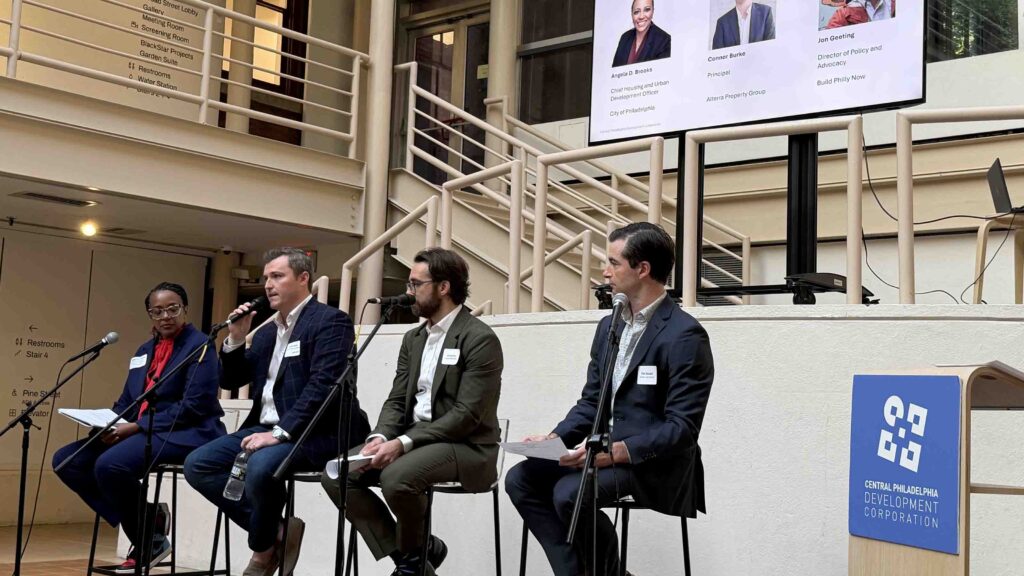
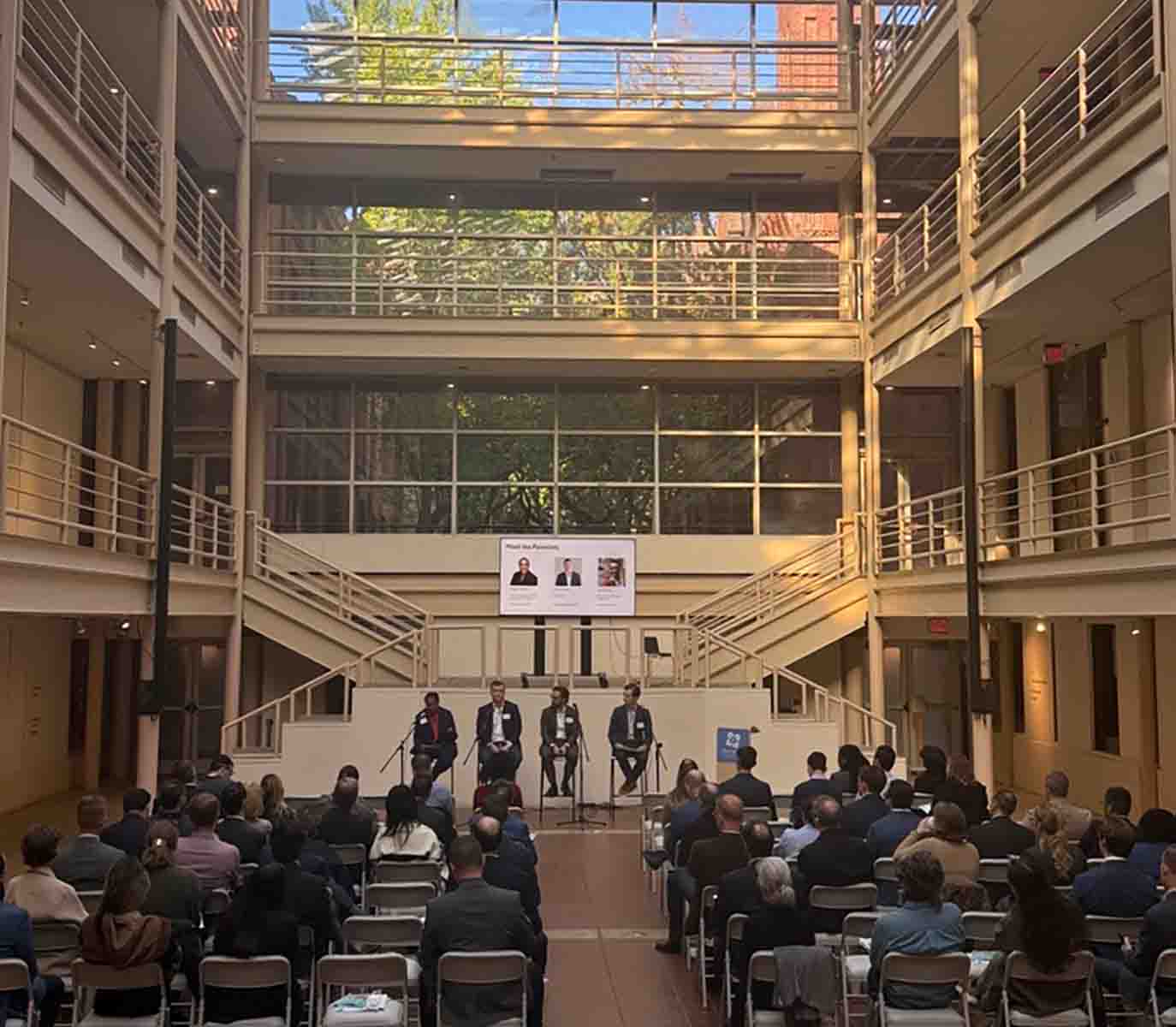
Clint Randall, Vice President of Economic Development, then moderated a panel that examined what’s driving downtown’s growth, the policy changes that could unlock thousands more homes, and what it will take to keep housing production moving as financing contracts.
Panelists:
- Angela Brooks, Chief Housing and Urban Development Officer, City of Philadelphia
- Connor Burke, Principal, Alterra Property Group
- Jon Geeting, Director of Policy and Advocacy, Build Philly Now
- Clint Randall (moderator), Vice President of Economic Development, Center City District
Read along for highlights from this program and learn more about how you can get involved with CPDC.
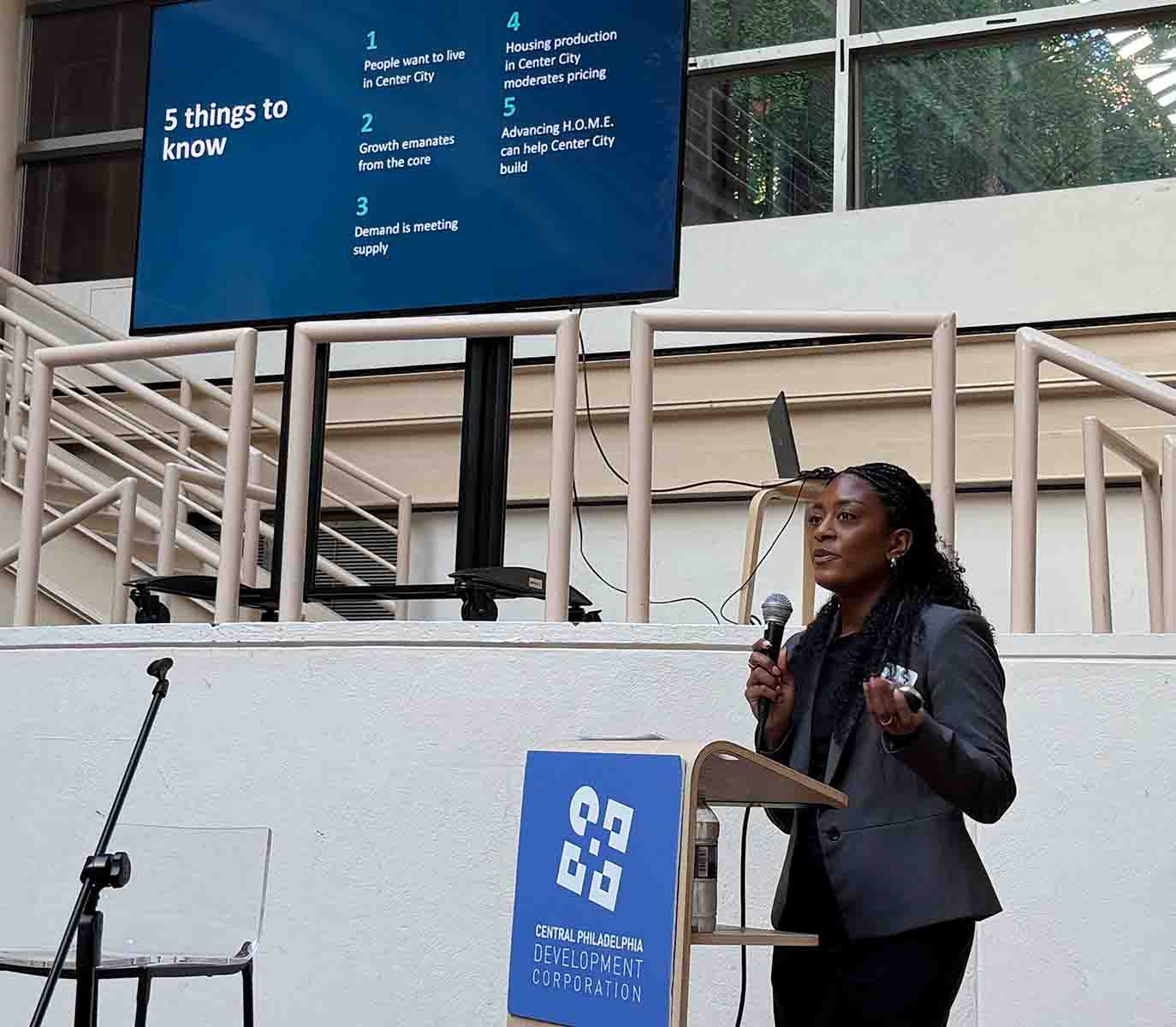
CCD’s latest housing report clearly finds that people want to live in Center City.
The area’s population has grown 28% since 2011, and one in eight Philadelphians now live in Greater Center City. Walkability, transit access, and proximity to jobs continue to draw residents, and growth is spreading beyond the core into adjacent neighborhoods like Fishtown and Kensington.
Demand has kept up with new supply: occupancy sits around 90%, absorption remains positive, and office conversions have added significant housing to the core. All that building is also moderating prices, helping keep rent increases below those of downtowns like Lower Manhattan and Boston. However, the pipeline is slowing as the 10-year tax abatement phases out and costs stay high. Market-rate supply alone won’t meet the need for affordable housing.
Two pipelines, one housing goal
Clint opened the panel by clarifying that CCD’s report counts market-rate units, while the city’s 30,000-unit Housing Opportunities Made Easy (H.O.M.E.) Initiative’s goal counts homes produced, preserved, or restored through roughly 40 city programs. Angela Brooks shared early progress: the city has received $400 million, the first tranche of an $800 million bond, which in the first quarter funded 773 emergency home repairs and 141 accessibility modifications, housing counseling for 2,700 households, and moves into Turn the Key homes for 63 families. New programs are launching now, including Curbside Appeal, which tackles blight block by block through residential façade improvements.
Angela noted that the two pipelines depend on each other. Drawing on her own experience as a renter, she explained that when cities don’t plan for where market-rate households will live, those households end up competing for naturally occurring affordable housing. She also urged developers in the room to share where city processes can improve, pointing to work underway with Bloomberg Associates and the Zoning Board of Adjustment.
Office conversions prove their worth
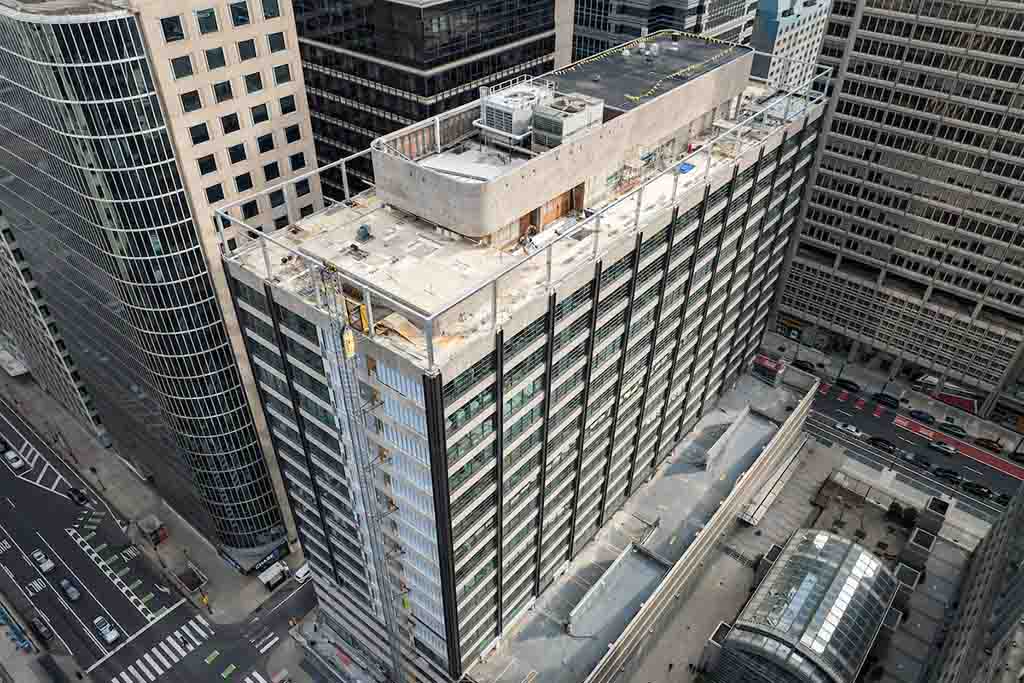
Connor Burke pointed to 17 Market West, the former Morgan Lewis headquarters at 1701 Market Street, as proof of downtown demand. Alterra completed the conversion in May 2025, and the building the building leased up in 10 months, “one of our fastest lease-ups’ in Philadelphia, Connor said.
That strength isn’t uniform across the city. Connor noted that some neighborhoods with heavy new supply are still seeing slower lease-ups and steeper concessions. As he sees it, rents stay naturally affordable in one of two ways: by building more supply or by making a place less desirable to live, and no one wants the latter.
Unlocking latent capacity
Clint highlighted one of the H.O.M.E. Initiative’s early wins: City Council’s elimination of parking minimums in CMX-4 and CMX-5, the zoning districts that cover Center City’s mid- and high-rise core. The change doesn’t ban parking; it allows developers to decide how much a project needs.
Jon Geeting, whose team at Build Philly Now ran the numbers for CCD’s report using parcel-level property data, explained that those districts are built out to only about 62% of what zoning allows, leaving roughly 66 million square feet of unused capacity. Under the old minimum of 0.3 spaces per unit, building out that capacity would have required roughly 31,000 parking spaces, or about 11 million square feet of garage, at an estimated cost between $0.9 billion and $2.3 billion. The benefits go beyond cost. “Parking minimums are also a really sneaky density check, because you have to dig down to build up,” Jon said. He called extending the reform to CMX-3, the only mixed-use district that still requires parking, “the next natural agenda item,” one that could save another $700 million to $1.2 billion.
Bringing life back to Market East
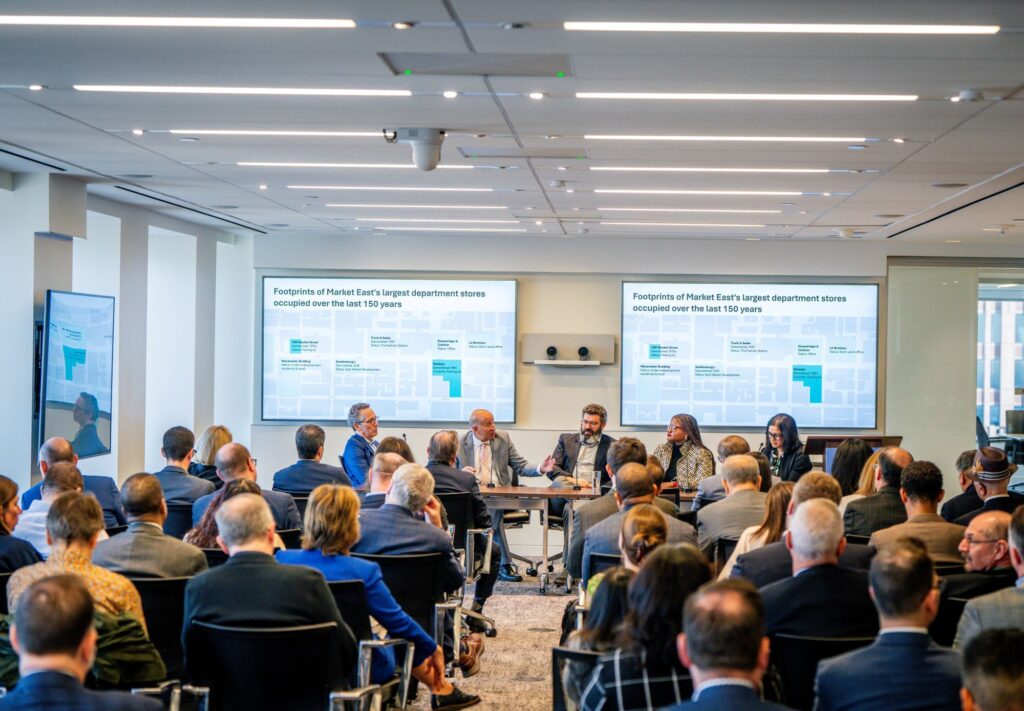
Turning to Market East, Clint noted that before National Real Estate Development’s East Market project, there were zero housing units on Market Street between Independence Mall and City Hall. Today there are about 500, with 622 more on the way inside the Wanamaker Building. Angela said the corridor’s existing transit infrastructure makes it a natural place for housing, and that the city is gathering the data needed to guide its development and identify lending partners.
Meanwhile, Connor, whose firm is a partner in the Wanamaker redevelopment, said that West Market Street has thrived since the pandemic because people live, work, shop, and eat there around the clock, something Market East lacks today. “It’s not a 24/7 neighborhood right now,” he said, adding that Wanamaker only scratches the surface, and the blocks to the east need to follow. Jon said that extending the city’s transit-oriented communities overlay, which now covers 13 stations, to the stops from City Hall to 2nd Street could open capacity for up to 20,000 units.
Incentivizing tougher conversions
Clint raised the idea of a targeted 20-year tax abatement for difficult conversions, a tool authorized at the state level that so far only Pittsburgh has adopted. Jon walked through the variables still being modeled and noted that for 19 struggling office buildings and 42 more potential candidates, conversion could raise tax revenue even during the abatement period. “The question might not be how much money we’re losing; it might be how much could we stand to gain,” he said.
Connor agreed, pushing back on what he called a misconception that abatements take assessed value off the tax rolls. Many of these buildings have already lost so much value, he said, that once they’re reassessed after conversion, they contribute more than they did before. “You’re actually growing the tax base.”
Affordability in the heart of downtown
High land values and construction costs mean Center City isn’t likely to produce affordable housing at scale. Even so, Alterra’s project at 2012 Chestnut Street, a partnership with the Philadelphia Housing Authority, will bring 121 affordable units downtown. When asked about the federal approval hurdles that project faced, Angela said uncertainty in Washington is part of why the city chose to fund the H.O.M.E. Initiative itself.
Jon described Center City as a “development sink” for the whole city, since every unit added downtown helps hold down citywide prices. To reach deeper affordability, he proposed a $50 million to $100 million public housing production fund, modeled on one in Montgomery County, Maryland, to offer subordinate loans for some of the nearly 2,700 permitted but stalled units in Greater Center City. He also argued for getting the most out of mid-rise buildings up to six stories, which are among the cheapest to build per square foot, and previewed upcoming Build Philly Now research on single-stair “point access block” buildings. Allowing them could add 1,900 to 2,600 homes in Greater Center City by making small apartment buildings feasible on the area’s many narrow lots.
Looking ahead
When asked what investments will sustain Center City’s growth, the panelists kept returning to jobs and transit. Connor called job growth “the rising tide to lift all boats,” noting that without the population and employment growth seen in Nashville, Austin, and New York, new buildings will struggle to fill. Jon pointed to SEPTA’s Reimagining Regional Rail plan as a chance to run frequent, all-day service that could help Philadelphia grow into a 10-million-person region with Center City at its hub. Angela stated the need for safe, clean transit and for making it “quicker, faster, easier” to do business with the city Jon’s wish was more practical: having plans examiners record unit and parking counts so the city can better measure its progress.
For 2027 and 2028, the panel expects housing production to slow. Connor said that “a lot of the easier” office conversions have already been done, and that beyond Wanamaker there is little in the core pipeline. Angela expects large gaps in requests for public subsidy to continue, which will require creative financing tools.
During audience Q&A, Angela framed the moment nationally: the need for housing isn’t political, even if how to pay for it is. She encouraged attendees to keep sharing data and stories with their elected officials and noted that the city’s forthcoming vacant land strategy will consider large city-owned parcels for housing.
Get involved
Interested in attending our next event? Learn how you can become a member of the Central Philadelphia Development Corporation and attend our member-only events and panels by contacting Lauren Smith, Director of Research & Special Projects, at cpdc@centercityphila.org.